
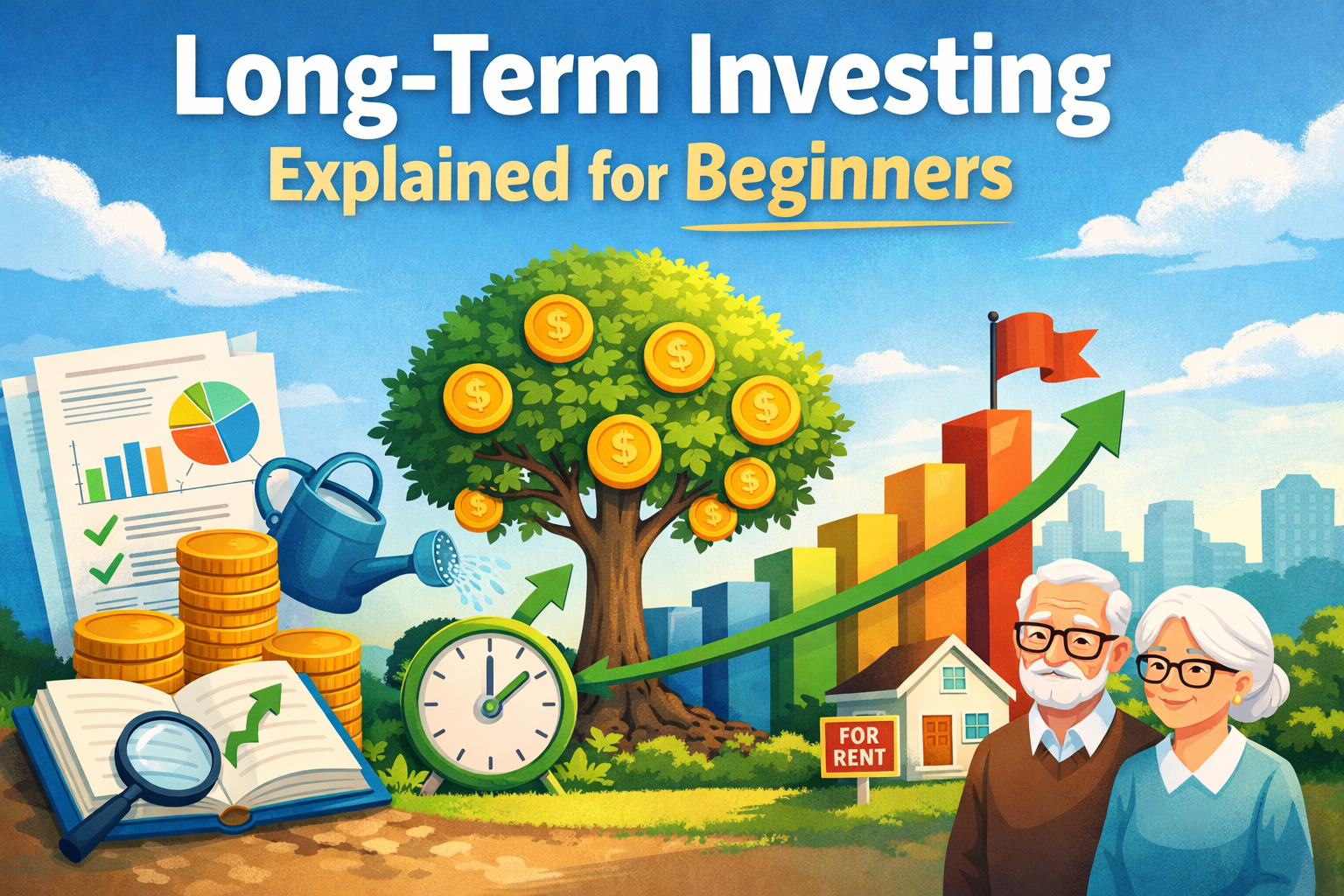
Long-term investing is a financial approach that focuses on building wealth gradually by staying invested over many years. Instead of reacting to short-term market fluctuations, long-term investors rely on patience, consistency, and the long-term growth of the economy.
This article explains long-term investing in a simple, neutral, and educational manner. It is designed for beginners with no prior investing knowledge and covers concepts such as compounding, diversification, risks, behavioral factors, planning, and frequently asked questions.
What Is Long-Term Investing?
Long-term investing means purchasing financial assets and holding them for an extended period, usually five years or more. The goal is not to profit from short-term price changes but to benefit from long-term growth, reinvested income, and the power of compounding.
This approach is based on the idea that while markets may fluctuate in the short term, they tend to grow over longer periods as economies expand, businesses innovate, and productivity improves. Long-term investing aligns your money with long-range financial plans instead of day-to-day market movements.
Common long-term investment options include:
- Equity shares of established companies
- Index funds and diversified mutual funds
- Exchange-Traded Funds (ETFs)
- Government and corporate bonds
- Retirement and pension accounts
- Income-generating real estate
Long-term investing is often associated with financial goals that are several years away, such as retirement or education planning. It can also support intermediate goals like building a home down payment or achieving financial independence at a later stage in life.
Why Long-Term Investing Matters
Long-term investing matters because it reflects realistic financial behavior and timelines. Wealth creation typically occurs gradually rather than instantly, and a long-term investing strategy respects that reality.
Short-term price movements are often influenced by market sentiment, news events, or speculation. Over time, however, asset prices tend to reflect economic fundamentals such as earnings, cash flows, and productivity gains, which benefits disciplined long-term investing.
Long-term investing is important because it:
- Reduces the impact of market volatility across multi-year periods
- Encourages disciplined saving and investing habits
- Supports compounding returns through automatic reinvestment
- Minimizes emotional and impulsive decision-making
- Aligns with long-term financial goals like retirement and education
For beginners, long-term investing provides structure and clarity in a complex financial environment. It offers a simple framework: invest regularly, stay diversified, and remain invested for many years.
How Long-Term Investing Works (Detailed Example)
Long-term investing works by allowing investments to grow through appreciation and reinvestment over time. Instead of frequently buying and selling, a long-term investor sticks to a plan and lets time do most of the work.
Example of long-term investing:
An individual invests ₹3,000 per month in a diversified equity mutual fund for 35 years. The total contribution over this period would be ₹12,60,000. Assuming a long-term average annual return of 9–10%, the final investment value could be many times higher due to compounding.
The process of long-term investing involves:
- Consistent contributions, such as monthly SIPs (Systematic Investment Plans)
- A long investment horizon, usually several decades
- Reinvestment of dividends, interest, or bonuses
- Staying invested during market downturns and avoiding panic selling
Instead of trying to predict short-term market highs and lows, the investor focuses on investing whenever money is available. Over time, this can average out the purchase price and create a disciplined long-term investing routine.
The Power of Compounding in Long-Term Investing
Compounding plays a central role in long-term investing. It occurs when earnings from an investment generate additional earnings, creating a snowball effect over time.
The effect of compounding in long-term investing increases with:
- Longer investment duration
- Regular reinvestment of income
- Consistent contributions, even if small
Starting long-term investing early, even with small amounts, can lead to meaningful results over decades. The longer money remains invested, the more visible the compounding effect becomes on your portfolio value.
Compounding can help offset inflation over the long term, especially when investing in growth-oriented assets like equities. Long-term investing rewards patience and consistency more than one-time, large contributions made late.
Key Benefits of Long-Term Investing
1. Gradual Wealth Accumulation
Long-term investing allows wealth to grow steadily rather than relying on unpredictable gains. This is particularly useful for goals that are many years away, including retirement and higher education.
2. Lower Costs and Taxes
Reduced trading activity in long-term investing leads to lower transaction and tax costs. Fewer buy and sell decisions also mean fewer chances of making costly timing mistakes that reduce returns.
3. Reduced Stress
Long-term investors do not need to track markets daily. This can improve emotional well-being and reduce the temptation to react to every piece of news or social media headline.
4. Goal-Oriented Planning
Long-term investing aligns well with life goals such as retirement, children’s education, or long-term healthcare needs. Investments are chosen and structured around timelines rather than short-term headlines.
5. Accessibility for Beginners
Long-term investing can begin with small, regular investments. Many platforms allow low minimum investment amounts, making it easier for beginners to start and scale up later.
6. Potential to Outpace Inflation
Over long periods, growth-oriented investments used in long-term investing, such as equities and equity funds, have historically generated returns that exceed inflation in many markets.
7. Simpler Decision-Making
A long-term investing mindset reduces the need for frequent decisions about when to enter or exit the market. Investors can focus on quality, diversification, and asset allocation instead of short-term predictions.
Risks and Limitations of Long-Term Investing
1. Market Risk
Markets may experience prolonged downturns, and long-term investing cannot fully avoid this. Even over several years, returns can be lower than expected, and there is no guarantee of positive results.
2. Inflation Risk
Returns may not always keep pace with inflation, especially for conservative long-term investing strategies that focus mainly on capital preservation rather than growth.
3. Concentration Risk
Lack of diversification can increase losses. Relying heavily on a single stock, sector, or country can be risky even with a long-term investing horizon.
4. Liquidity Risk
Some long-term investments may not be easily sold when money is needed. Real estate, certain bonds, or locked-in retirement plans may have restrictions or longer exit periods.
5. Psychological Risk
Fear, impatience, and overconfidence can affect long-term investing decisions. Emotional reactions may lead investors to abandon their plans at unfavorable times.
6. Goal Mismatch
Using long-term investing strategies for short-term goals can be problematic. Money needed in a few months or years should generally not be exposed to high volatility.
Long-Term Investing vs Short-Term Trading
Long-term investing and short-term trading differ in purpose, time horizon, and behavior.
- Long-term investing focuses on years or decades and aims to benefit from economic growth.
- Trading focuses on short-term price movements, from minutes to months.
- Long-term investing relies on fundamentals, such as earnings and cash flows.
- Trading often involves frequent buying and selling, higher costs, and more emotional stress.
For most beginners, long-term investing is more practical and easier to follow. It does not require constant monitoring, screen time, or short-term price forecasting.
Asset Allocation for Long-Term Investing
Asset allocation determines how investments are divided among different asset classes, such as equities, debt, and cash. It is a key driver of long-term investing risk and return.
Factors influencing long-term investing allocation include:
- Age and investment horizon
- Risk tolerance and ability to handle volatility
- Income stability and job security
- Financial goals and their timelines
A diversified allocation helps manage risk while pursuing growth. Many long-term investors gradually shift from higher equity exposure in early years to more conservative allocations as they approach retirement or major financial goals.
Diversification and Risk Management in Long-Term Investing
Diversification reduces reliance on any single investment. It spreads risk across different assets so that poor performance in one area may be balanced by better performance in another.
A diversified long-term investing portfolio may include:
- Different industries and sectors
- Multiple asset classes such as equity, debt, and real estate
- Domestic and international exposure
While diversification cannot eliminate losses, it helps manage uncertainty and smooth long-term returns. It also reduces the impact of unexpected events affecting a single company or sector.
Behavioral Aspects of Long-Term Investing
Investor behavior plays a major role in the success of long-term investing. Even a well-designed portfolio can underperform if decisions are driven by emotion.
Common behavioral challenges in long-term investing include:
- Fear during market declines leading to panic selling
- Overconfidence during market highs leading to excessive risk-taking
- Chasing past performance instead of following a plan
- Checking portfolios too frequently and reacting to short-term movements
Long-term investing emphasizes emotional discipline and rational decision-making. Setting clear rules and expectations before investing can help manage reactions during stressful market conditions.
Role of Rebalancing in Long-Term Investing Portfolios
Rebalancing involves adjusting asset allocation periodically when it drifts away from the original plan due to market movements. It keeps a long-term investing portfolio aligned with the intended risk level.
Rebalancing helps:
- Maintain desired risk levels over time
- Prevent overexposure to one asset or sector
- Encourage disciplined investing and selling high / buying relatively lower
Most long-term investors rebalance annually or semi-annually. Some also use threshold-based rebalancing, where they adjust only when allocations deviate beyond a certain percentage from the target.
Common Long-Term Investing Mistakes and Myths
Mistake: Expecting Guaranteed Returns
No long-term investing strategy guarantees returns. Even diversified portfolios can experience periods of underperformance or loss.
Mistake: Ignoring Portfolio Review
Periodic review is essential to ensure investments still match goals, risk tolerance, and time horizon. Ignoring changes in personal circumstances can lead to mismatched portfolios.
Myth: Long-Term Investing Is Too Slow
Gradual growth through long-term investing can be substantial over time, especially when compounding works for several decades. Consistency often matters more than speed.
Myth: Only High Income Earners Can Invest
Regular small investments can also grow significantly in a long-term investing plan. Automated SIPs and low minimums make this approach accessible to many income levels.
Mistake: Following Tips and Rumors
Relying on unverified tips or short-term rumors can distract from a long-term investing plan. Decisions are more reliable when based on research, suitability, and goals.
Myth: Long-Term Investors Never Sell
Long-term investing does not mean holding every investment forever. Selling may be appropriate if goals change, fundamentals deteriorate, or rebalancing is required.
How to Start Long-Term Investing (Step-by-Step)
Beginners can follow a simple process to begin their long-term investing journey. The focus should be on clarity, safety, and gradual learning.
- Define your financial goals. Decide what you are investing for, such as retirement, education, or wealth creation over 15–30 years.
- Decide your time horizon. Classify goals into short-term (up to 3 years), medium-term (3–5 years), and long-term (more than 5 years).
- Assess your risk tolerance. Consider how you react to market losses and how much fluctuation you can comfortably handle.
- Build an emergency fund. Keep some money in liquid, low-risk instruments before committing to long-term investing.
- Choose suitable investment products. For many beginners, diversified mutual funds or index funds are a simple way to start long-term investing.
- Decide a monthly investment amount. Start with an affordable figure and aim to increase it gradually as income grows.
- Automate contributions. Use systematic plans to invest regularly without relying on short-term market forecasts.
- Track but do not obsess. Review once or twice a year and avoid checking daily price movements.
- Stay educated. Continue learning about asset classes, risk, taxation, and financial planning.
Types of Long-Term Investing Options
Different instruments can be used within a long-term investing strategy. Each has its own risk and return profile.
1. Equity Shares and Equity Funds
These represent ownership in companies and are suitable for long-term investing focused on growth. Volatility may be high in the short run, but they offer higher return potential over long durations.
2. Debt Instruments
Bonds, debt funds, and fixed-income products provide relatively stable income and lower volatility compared to equities. They are useful for balancing risk in a long-term investing portfolio.
3. Index Funds and ETFs
These track market indices and offer broad diversification in a single product. They are often low-cost and simple to understand, making them beginner-friendly choices for long-term investing.
4. Retirement and Pension Products
Retirement accounts and pension schemes are specifically structured for long-term investing horizons. They may offer tax advantages and disciplined investing through mandatory contributions.
5. Real Estate
Income-generating real estate can be a part of a long-term investing portfolio, especially for rental income and potential capital appreciation. However, it typically requires larger initial capital and careful due diligence.
Tax Considerations in Long-Term Investing (General)
Tax rules vary by country, but in many systems, long-term investments are taxed differently from short-term holdings. Understanding these basics helps in planning long-term investing more efficiently.
- Long-term capital gains are often taxed at different rates compared to short-term gains.
- Tax-advantaged accounts can offer benefits for retirement and long-term goals.
- Holding investments longer may reduce the impact of frequent taxable events.
Investors should understand local tax rules or consult a qualified professional before making decisions. Tax planning is a supporting factor in long-term investing, not the only reason to invest.
Behavioral Tips for Staying Committed to Long-Term Investing
Maintaining a long-term investing approach is often harder than starting it. Simple practices can help investors remain on track.
- Focus on goals rather than daily price changes.
- Avoid comparing portfolios frequently with others.
- Limit exposure to sensational financial news that encourages short-term reactions.
- Write down an investment plan and refer to it during volatile periods.
- Use diversification and asset allocation to stay within a comfortable risk range.
By building habits such as automated investing and periodic reviews, investors can reduce the urge to time markets or chase trends and stay loyal to long-term investing principles.
Helpful Long-Term Investing Resources
To deepen your understanding of long-term investing, you can explore:
- Long-term investing definition and basics – overview of long-term investing concepts and tax treatment.
- Beginners’ guide to asset allocation, diversification, and rebalancing – educational resource on portfolio construction.
For a detailed beginner-friendly guide to mutual funds that support long-term investing, you can also read our article on Stock market basics for beginners.
Frequently Asked Questions (FAQ)
1. What qualifies as long-term investing?
Long-term investing generally refers to holding investments for more than five years, and often much longer for goals like retirement.
2. Is long-term investing suitable for beginners?
Yes, long-term investing is suitable for beginners when portfolios are diversified and aligned with risk tolerance. It provides a structured way to grow wealth without daily decision-making.
3. Can long-term investments lose value?
Yes, particularly in the short term or during extended market downturns. Long-term investing reduces, but does not remove, the risk of loss.
4. Should dividends be reinvested?
Reinvestment supports compounding and can enhance long-term investing growth. Some investors later choose to use dividends as income after reaching certain goals.
5. How often should investments be reviewed?
Once or twice a year is generally sufficient for long-term investing portfolios, unless major life events or large income changes occur.
6. Is market timing necessary?
Time in the market is generally more important than timing the market. Consistent long-term investing often works better than trying to predict short-term moves.
7. Are long-term returns guaranteed?
No guarantees exist. Historical patterns provide guidance, but future returns for long-term investing depend on many factors, including economic conditions and policy changes.
8. Can long-term investing beat inflation?
Historically, diversified equities used in long-term investing have often beaten inflation over long periods in many economies, although this is not assured.
9. Is professional advice required?
Advice can help align long-term investing with goals, risk tolerance, and tax considerations. Some investors manage their own portfolios, while others prefer professional support.
10. What is the biggest risk for beginners?
Emotional decision-making is one of the biggest risks in long-term investing. Exiting during market falls or chasing recent winners can damage long-term results.
11. How much money is required to start?
Many platforms allow starting long-term investing with small amounts through systematic monthly investments. The key is consistency and gradual increase over time.
12. Can long-term investors hold cash?
Yes, holding some cash within a long-term investing plan can provide flexibility and reduce anxiety. However, excessive cash for very long periods may limit growth and struggle against inflation.
13. Is diversification always necessary?
Diversification is not mandatory but is generally recommended in long-term investing. Concentrated portfolios can deliver higher returns but also carry higher risk if expectations are not met.
Conclusion
Long-term investing is a structured and disciplined approach to building financial security. By focusing on patience, diversification, and ongoing education, beginners can navigate financial markets with greater confidence.
Understanding both the benefits and the risks of long-term investing helps set realistic expectations and supports informed decision-making over time. The combination of clear goals, regular contributions, and emotional discipline can make long-term investing a powerful tool for long-term wealth creation.
Disclaimer
This article is for educational purposes only and does not constitute financial, investment, tax, or legal advice. Always consult a qualified financial advisor or planner before making investment decisions or implementing a long-term investing strategy.