
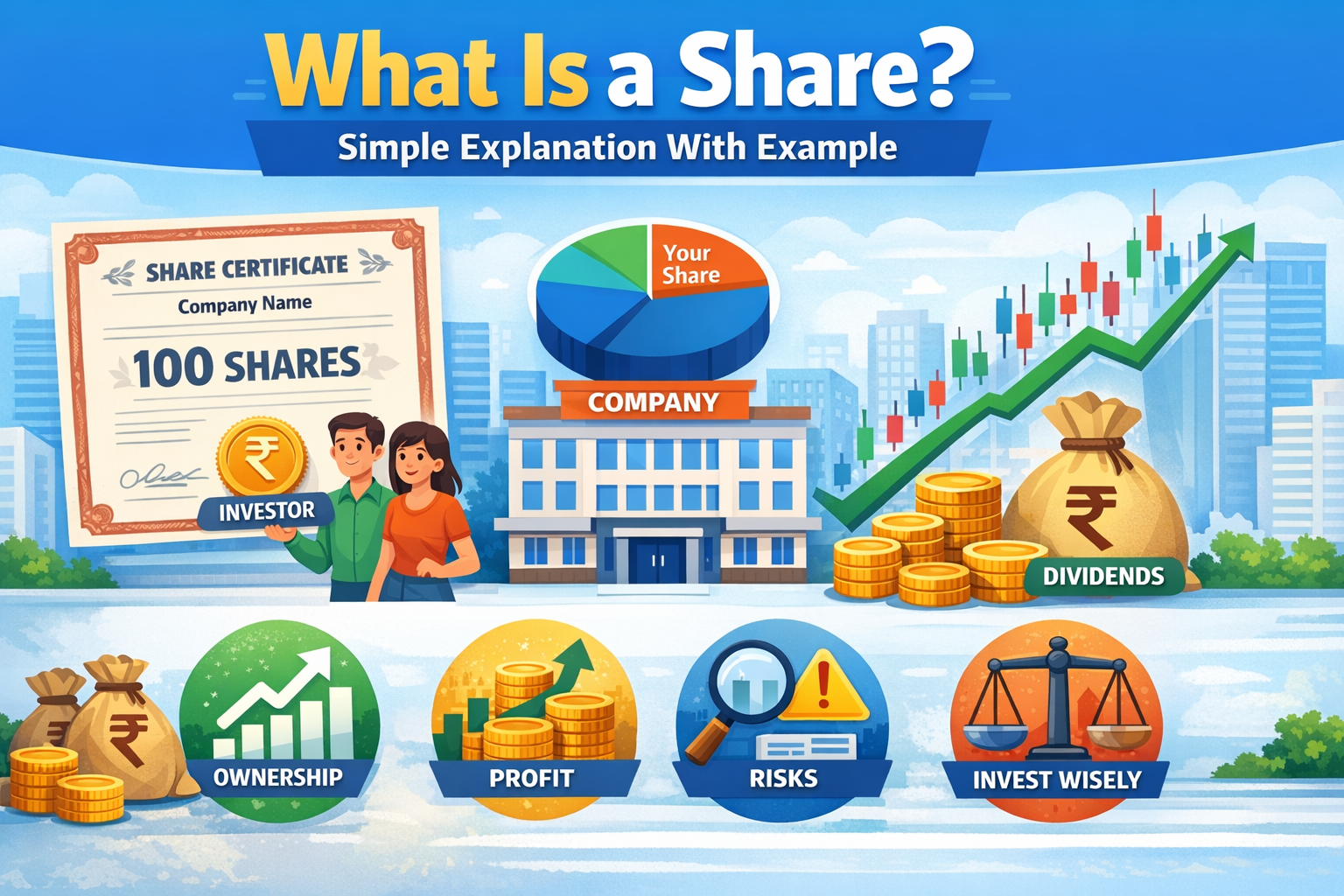
A share is one of the most basic and important concepts in investing and the stock market. Understanding what a share is helps beginners take their first confident step toward building wealth. In simple terms, a share represents ownership in a company. If you are new to investing and wondering what is a share, this complete guide will answer your questions step by step.
If you have ever heard someone say, “I own shares of a company,” it means they own a small part of that business. This article explains what a share is in a clear, beginner-friendly way, using easy examples, practical explanations, and simple language. By the end, you will fully understand how shares work, why they matter, and what to watch out for.
What Is a Share? Meaning and Explanation
A share is a unit of ownership in a company. When a company wants to raise money to grow its business, it divides its ownership into small parts called shares. These shares are then sold to investors. So, when you ask “what is a share in simple words?”, the answer is: it is a tiny slice of a business that you can buy and own.
When you buy a share, you become a shareholder (also called a stockholder). This means you own a portion of the company, even if that portion is very small. Your ownership percentage depends on how many shares you own compared to the total number of shares the company has issued.
For example, if a company has issued 1,000 shares and you own 10 of them, you own 1% of that company. This ownership gives you certain rights, such as:
- A claim on a portion of the company’s profits
- The right to vote on certain company decisions (in many cases)
- The potential to benefit if the company grows in value
Shares are commonly bought and sold on stock exchanges like the NSE or BSE in India, or the NYSE and NASDAQ internationally. Their prices change daily based on demand, supply, company performance, and market conditions.
Why Shares Matter for Investors
Shares matter because they connect individuals, businesses, and the economy. They are one of the main ways companies raise money and one of the most popular ways people invest. When you clearly understand what is a share, it becomes easier to see how the stock market supports business growth and job creation.
From a company’s point of view, issuing shares helps raise capital without taking loans. Instead of paying interest, the company shares ownership with investors. This money can be used to:
- Expand operations
- Develop new products
- Enter new markets
- Pay off existing debt
From an investor’s point of view, shares provide an opportunity to grow wealth over time. Historically, shares have delivered higher returns than many traditional savings options, especially over the long term.
On a broader level, shares help fuel economic growth. They allow everyday people to participate in the success of businesses, large and small. This shared ownership model is a key reason modern economies can grow and innovate.
How Shares Work (With a Simple Example)
To understand how shares work, let’s look at a very simple example. This will make the idea of what is a share much clearer for beginners.
Example: A Small Company
Imagine a company called BrightTech. The company needs ₹10,00,000 to expand its business. Instead of borrowing from a bank, BrightTech decides to issue shares.
BrightTech creates 10,000 shares, each priced at ₹100. These shares are offered to the public.
- Total shares issued: 10,000
- Price per share: ₹100
- Total money raised: ₹10,00,000
If you buy 100 shares of BrightTech:
- You invest ₹10,000
- You own 1% of the company (100 ÷ 10,000)
If BrightTech performs well and grows, more investors want to buy its shares. The share price may rise to ₹150. Your 100 shares would then be worth ₹15,000.
If the company earns profits, it may distribute part of those profits to shareholders as dividends. This means you can earn income in addition to price appreciation.
However, if the company performs poorly, the share price may fall. This is why shares carry both opportunity and risk.
Benefits of Shares for Long-Term Investors
Investing in shares offers several advantages, especially for long-term investors. Below are the key benefits explained simply. These points will also help you understand what is a share in terms of real-life benefits.
1. Ownership in a Company
Shares give you partial ownership in a business. As the company grows, your ownership stake becomes more valuable.
2. Potential for High Returns
Over the long term, shares have historically provided higher returns compared to fixed deposits or savings accounts. Successful companies can multiply investors’ wealth.
3. Dividend Income
Some companies share their profits with investors through dividends. This provides regular income, especially from stable, mature companies.
4. Liquidity
Shares can be easily bought and sold on stock exchanges during market hours. This makes them more liquid than many other investments like property.
5. Protection Against Inflation
As companies grow and increase prices, their profits may rise. This can help shares outpace inflation over time.
6. Transparency and Regulation
Public companies are regulated and must disclose financial information. This helps investors make informed decisions.
Risks and Limitations of Shares
While shares offer many benefits, they also come with risks. Every investor should understand these before investing.
1. Market Risk
Share prices can fluctuate due to market conditions, economic changes, or global events. Even good companies can see temporary price declines.
2. Business Risk
If a company performs poorly or faces competition, its share price may fall. In extreme cases, a company can fail.
3. Volatility
Share prices can change rapidly. This volatility can be stressful for short-term investors.
4. No Guaranteed Returns
Unlike fixed deposits, shares do not guarantee returns. Profits depend on company performance and market conditions.
5. Emotional Decision-Making
Fear and greed can lead investors to buy at high prices or sell during panic. This behavior often leads to losses.
Types of Shares: Equity and Preference
When people talk about shares, they usually mean equity shares, but companies can issue different types of shares with different rights and features. Understanding the broad categories helps you know what exactly you are buying when you learn what is a share.
Equity Shares
Equity shares represent basic ownership in a company and usually come with voting rights, which allow shareholders to vote on important matters like electing directors or approving major decisions. Equity shareholders are last in line during liquidation, but they benefit the most if the company grows and its value increases over time.
Preference Shares
Preference shares typically give investors a fixed dividend and priority over equity shareholders when dividends are paid or if the company is liquidated. However, preference shareholders usually have limited or no voting rights, so they do not participate much in company decisions.
For most retail investors, the shares bought on stock exchanges are equity shares, so the main focus is usually on company growth, dividends, and long-term wealth creation rather than fixed payouts.
How Share Prices Are Decided
A common doubt among beginners is, “Who decides the price of a share?”. In reality, the price is not decided by a single person or authority, but by the forces of demand and supply in the stock market.
When more people want to buy a share than sell it, demand is higher than supply, so the price tends to move up. When more people want to sell than buy, supply is higher than demand, so the price tends to fall. Over time, news, earnings results, interest rates, and even global events can influence how investors feel about a company, which then affects demand and supply.
In the primary market (like an IPO), the company and its advisors estimate a fair price range based on financial statements, growth prospects, and investor appetite. Once the share is listed and begins trading on an exchange, daily trading activity among buyers and sellers continuously sets the live market price.
New Investor Checklist Before Buying Shares
Before buying your first share, it helps to follow a simple checklist so you avoid impulsive decisions and reduce basic mistakes. Think of this checklist as a small routine you follow each time you consider an investment.
- Understand the business: Make sure you know what the company does, how it makes money, and who its main customers are.
- Check basic financials: Look at sales growth, profit trends, and debt levels to see whether the business is stable and improving over time.
- Study the management: Read about the promoters and key executives to judge their track record, reputation, and transparency.
- Look at valuation: Compare the company’s price-to-earnings (P/E) ratio, price-to-book (P/B) ratio, or other simple metrics with its peers.
- Know your holding period: Decide whether you plan to hold for years as an investor or trade for short-term price movements.
- Diversify: Avoid putting too much money into a single company or sector; spreading investments helps manage risk.
- Set a risk limit: Decide in advance how much loss you can tolerate on a single share or in your entire portfolio.
Following this checklist does not guarantee profits, but it creates discipline and helps you think like a serious investor rather than a speculator. Even simple checks, done consistently, can protect you from many obvious mistakes.
Shares vs Other Investment Options
To understand the full picture of what is a share, it helps to compare shares with other common investment choices like fixed deposits, gold, and real estate. Each asset type has its own risk, return, and liquidity profile.
- Fixed Deposits: Offer stable and predictable interest income with low risk, but returns may be lower than inflation over long periods.
- Gold: Acts as a store of value and hedge during crises, but does not generate regular income like interest or dividends.
- Real Estate: Can provide rental income and potential appreciation, but requires large capital, has low liquidity, and involves maintenance and legal work.
- Shares: Offer high long-term growth potential, dividend income, and easy buying/selling, but come with higher short-term volatility.
An ideal portfolio usually combines different asset classes so that no single risk can damage your entire wealth. Shares often become the growth engine of the portfolio, while other assets add stability and diversification.
Beginner Strategy: How to Use Shares Wisely
Instead of randomly buying whatever is popular in the news, beginners should follow a simple, rules-based approach to investing in shares. This helps you stay consistent even when markets feel confusing or volatile.
- Start with learning: Spend some time understanding basic concepts like what is a share, stock exchanges, Demat accounts, and order types.
- Define goals: Decide why you are investing (retirement, children’s education, house purchase) and how many years you have.
- Begin with strong companies: Focus on financially healthy, well-known businesses with stable earnings and proven track records.
- Invest gradually: Use systematic investing (for example, monthly investments) instead of putting all money at once.
- Avoid constant trading: Frequent buying and selling generates costs and stress; long-term holding often works better for beginners.
- Review yearly: Check your portfolio once or twice a year, not every day; rebalance if any single share becomes too large.
By treating shares as long-term partners in your wealth-building journey, you shift your focus from short-term price noise to long-term business growth. This mindset usually leads to more stable and satisfying results.
Common Mistakes and Myths About Shares
Many beginners misunderstand shares. Clearing these myths helps investors make better decisions.
Myth 1: Shares Are Gambling
Investing is not gambling when done with research and a long-term view. Gambling relies on luck, while investing relies on analysis and patience.
Myth 2: You Need a Lot of Money
Today, you can start investing with small amounts. Many shares are affordable, and fractional investing is also available.
Myth 3: Shares Are Only for Experts
Anyone can learn the basics of investing. With the right knowledge, beginners can invest responsibly.
Myth 4: Short-Term Trading Is Better
Long-term investing often outperforms frequent trading. Time in the market is usually more important than timing the market.
Common Mistake: Lack of Diversification
Putting all money into one share increases risk. Diversifying across sectors and companies reduces potential losses.
Frequently Asked Questions (FAQ)
1. What is the difference between a share and a stock?
A share represents a single unit of ownership. Stock is a general term that refers to ownership in one or more companies.
2. Can I lose all my money in shares?
In rare cases, yes, if a company fails. However, diversification and careful investing greatly reduce this risk.
3. Are shares suitable for beginners?
Yes, beginners can invest in shares with proper learning and a long-term approach.
4. How do I earn money from shares?
You can earn through price appreciation and dividends.
5. What is a dividend?
A dividend is a portion of a company’s profit distributed to shareholders.
6. How long should I hold shares?
Long-term holding (years) is generally recommended for better results.
7. Are shares risky compared to mutual funds?
Individual shares are riskier than diversified mutual funds. Mutual funds spread risk across many companies.
8. Can I sell shares anytime?
Yes, listed shares can usually be sold during market hours on trading days.
Related Articles for Further Learning
If you want to go beyond the basic meaning of what is a share and learn how to actually analyse companies and build a long-term portfolio, the following guides will help you:
- Financial Statement Analysis Explained Simply – Understand balance sheets, profit and loss statements, and cash flow statements in plain language.
- Why Long-Term Investing Beats Short-Term Trading – Learn why patience and holding quality shares for years often works better than frequent trading.
- How the Stock Market Works Step by Step – A step-by-step explanation of how orders are placed, executed, and settled in the market.
- Fundamental Analysis Explained for Beginners – Learn how to evaluate a company’s business, financial health, and fair value.
- Long-Term Investing Explained for Beginners – A simple guide to building wealth gradually through disciplined, long-term investing in quality shares.
Conclusion: What Is a Share in One Line?
A share is simply a small piece of ownership in a company. By buying shares, you participate in the growth, success, and challenges of a business. Shares play a vital role in personal wealth creation, company growth, and the overall economy.
For beginners, understanding exactly what is a share lays the foundation for smart investing. While shares offer strong long-term potential, they also carry risks. Learning, patience, diversification, and discipline are key to success.
With the right approach, shares can become a powerful tool for building financial security over time.
Disclaimer: This article is for educational purposes only and does not constitute financial advice. Always consult a qualified financial advisor before investing.