
Table of Contents
- Meaning / Explanation
- Why It Matters
- How It Works / Concept
- How It Works / Examples
- Basic Compounding Formula
- How to Use Compounding in Real Life
- Benefits
- Risks / Limitations
- Common Mistakes / Myths
- FAQ Section
- Conclusion
The power of compounding is one of the most important concepts in personal finance and investing, yet it is also one of the most misunderstood. The power of compounding works silently over time, turning small and regular investments into significant wealth. Many beginners think compounding is complicated or only for experts, but in reality, it is simple and works best when started early.
The power of compounding means earning returns not only on your original investment but also on the returns that investment has already generated. This beginner-friendly guide explains compounding in clear language, with simple examples, real-life relevance, benefits, risks, and common mistakes—so anyone can understand and apply it confidently.
Meaning / Explanation
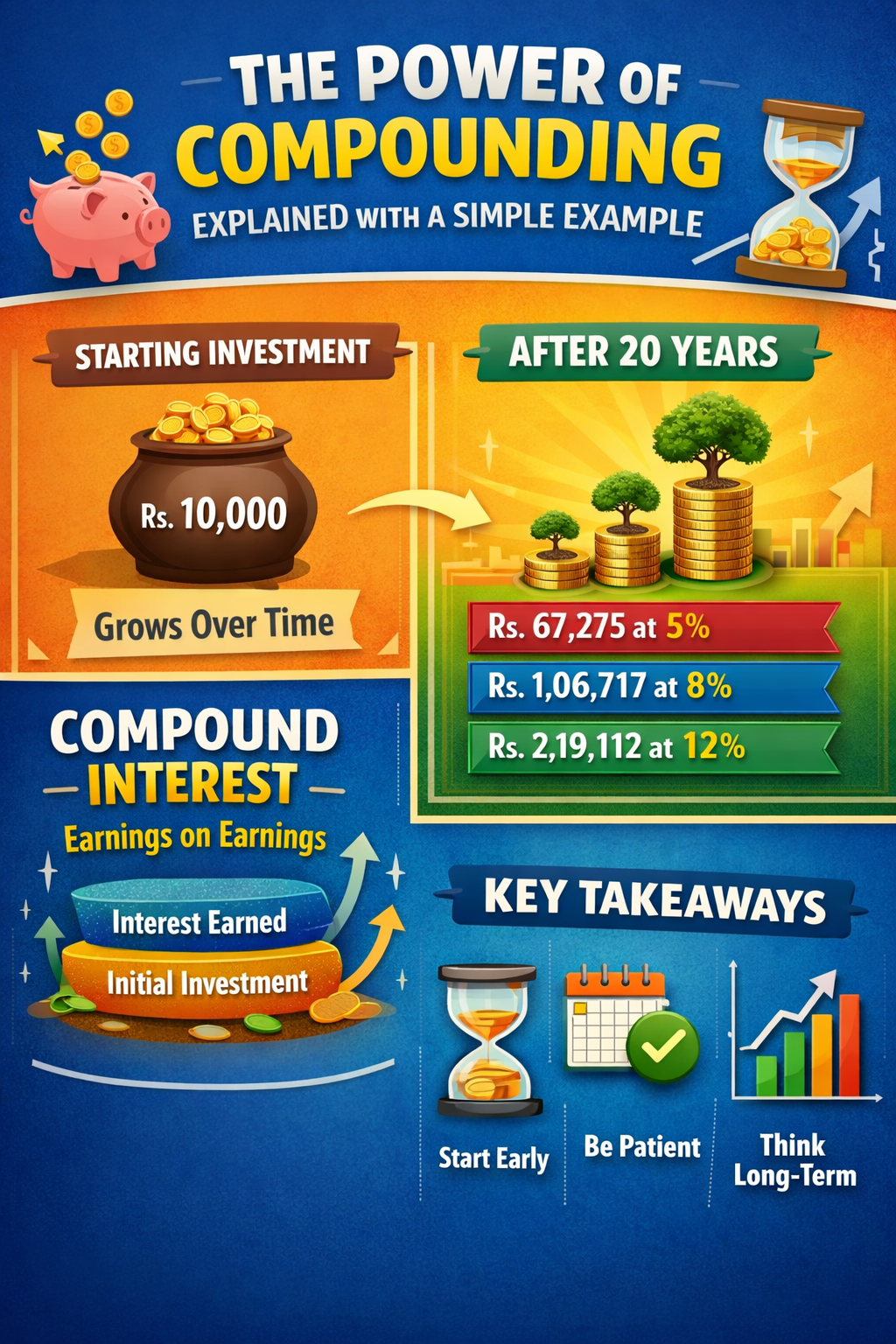
The power of compounding refers to the process through which money grows over time by earning returns not only on the initial amount invested, known as the principal, but also on the returns accumulated in previous periods. In simpler words, compounding means “interest on interest.” This concept is the foundation of long-term wealth creation and plays a crucial role in personal finance, investing, and even business growth.
When you invest money and earn returns, those returns are added back to your original investment. In the next cycle, returns are calculated on this higher amount. Over time, this repeated reinvestment causes growth to accelerate. The longer the time horizon, the more dramatic the effect of compounding becomes.
At first glance, compounding may appear slow and unimpressive. In the early years, the increase in value often looks small, which leads many beginners to underestimate its power. However, compounding is not linear; it is exponential. This means growth speeds up as time passes, creating a curve that rises sharply in later years.
Compounding applies to many areas of life beyond investing. For example, learning new skills compounds over time as knowledge builds on itself. In finance, however, compounding has a measurable and visible impact, making it one of the most reliable principles for achieving long-term financial security.
It is important to distinguish compounding from simple interest. Simple interest is calculated only on the principal amount, which results in steady but limited growth. Compounding, on the other hand, reinvests earnings, leading to significantly higher returns over long periods.
Understanding the power of compounding helps individuals make better financial choices, such as starting investments early, staying invested during market ups and downs, and avoiding unnecessary withdrawals that interrupt the compounding process.
Why It Matters
The power of compounding matters because it directly influences how wealth is created over time. It explains why people who start investing early often end up with significantly more money than those who start later, even if the latter invest larger amounts.
Time is the most important ingredient in compounding. Money needs time to grow, and compounding rewards patience more than aggressive short-term strategies. Every year you delay investing reduces the total time your money has to compound, and this lost time cannot be recovered.
Compounding also encourages disciplined financial behavior. When people understand that consistent investing and staying invested are key to long-term success, they are less likely to make emotional decisions based on short-term market movements.
For beginners, compounding provides motivation. Knowing that small monthly investments can grow into large sums over decades makes financial goals feel more achievable. It shifts the focus from chasing quick profits to building sustainable wealth.
In a broader sense, compounding helps individuals prepare for major life goals such as retirement, children’s education, home ownership, and financial independence. Without compounding, achieving these goals would require significantly higher savings and effort.
In today’s world, where inflation steadily reduces purchasing power, compounding becomes even more important. Investing money in instruments that compound over time helps protect wealth against inflation and ensures long-term financial stability.
How It Works / Concept
The power of compounding matters because time is the most critical factor in wealth creation. Even small amounts invested consistently can grow into large sums if given enough time. This is why financial experts emphasize starting early rather than investing large amounts later.
Compounding rewards patience and discipline. It encourages long-term investing and discourages frequent withdrawals or emotional decisions. People who understand compounding are more likely to focus on long-term goals such as retirement, children’s education, or financial independence.
In contrast, ignoring compounding often leads to underestimating the value of early investing and overestimating the ability to catch up later. Time lost can never be recovered in compounding.
How It Works / Examples
Let us understand the power of compounding with a few simple examples.
Imagine two people: Person A starts investing early, and Person B starts late.
Example 1: Simple Compounding on a Lump Sum
If you invest ₹10,000 at an annual return of 10%:
- Year 1: ₹10,000 + ₹1,000 = ₹11,000
- Year 2: ₹11,000 + ₹1,100 = ₹12,100
- Year 3: ₹12,100 + ₹1,210 = ₹13,310
Each year, interest is calculated on a growing amount. Over long periods, this growth becomes powerful. If the same ₹10,000 stays invested for 20 or 30 years at a similar rate, the final value becomes many times larger than the original amount, even though you never added extra money.
Example 2: Early vs Late Start (Lump Sum)
Person A invests ₹1,00,000 at age 25 at a 10% annual compound return and leaves it untouched until age 55 (30 years). Person B waits and invests ₹1,00,000 at age 35 at the same 10% return until age 55 (20 years). Person A’s investment has 10 extra years to compound, so the final amount at 55 is much higher than Person B’s, even though both invested the same amount.
Example 3: Monthly Investing (SIP Style)
Consider a simple monthly investing habit similar to a Systematic Investment Plan (SIP):
- You invest ₹5,000 per month.
- You continue for 20 years without stopping.
- You earn a reasonable long-term return from a diversified investment.
Over 20 years, your total contribution is ₹12,00,000 (₹5,000 × 12 × 20). Because of compounding, the final wealth can be several times your invested money, depending on the actual return rate. The key is that every monthly contribution starts earning returns, and those returns keep getting reinvested.
Example 4: Early vs Late Start (Monthly Investing)
Now imagine two friends investing monthly:
- Person A invests ₹5,000 per month from age 25 to 35 (10 years) and then stops but does not withdraw.
- Person B invests ₹5,000 per month from age 35 to 60 (25 years).
- Both earn the same average rate of return per year.
Even though Person B invests for more years and contributes much more money, Person A can still end up with a larger retirement corpus because the money started compounding earlier and had more years to grow. This clearly shows that time in the market is often more powerful than the amount invested later.
Basic Compounding Formula
The basic mathematical formula for compound interest on a lump sum is:
Future Value = Principal × (1 + r)n
Here, Principal is the amount you invest at the beginning, r is the rate of return per period (for example, per year), and n is the number of compounding periods. This simple formula explains why the power of compounding becomes dramatic when n is large.
For regular monthly investing, the formula is slightly different and uses a series of contributions, but the idea remains the same: each contribution grows for a certain number of periods, and all of them compound together to create a much larger future value.
How to Use Compounding in Real Life
Applying the power of compounding in daily financial life is simple. The main ingredients are time, consistency, and choosing suitable financial products.
- Start Early: Begin investing as soon as possible, even with small amounts. Waiting for a “perfect time” often results in lost years of compounding.
- Invest Regularly: Set up a monthly investment (for example, a SIP in mutual funds or recurring deposits) so that money is invested automatically without relying on mood or market timing.
- Reinvest Earnings: Choose options where interest, dividends, or returns are reinvested instead of taken out as cash. This is how “interest on interest” is created.
- Avoid Frequent Withdrawals: Try not to break long-term investments for short-term expenses. Every withdrawal shrinks the base amount and breaks the compounding chain.
- Increase Contributions Over Time: As income grows, gradually increase your monthly investment. Even small step-ups can greatly boost long-term wealth.
- Match Investments to Goals: Use compounding for long-term goals such as retirement, children’s education, or buying a house, where you have 10, 15, or 20+ years for money to grow.
- Stay Patient During Volatility: In market-linked products like equity mutual funds, values may fluctuate in the short term. Staying invested allows compounding to work over the long term.
Benefits
The power of compounding offers several long-term benefits.
- Wealth Creation: Long-term compounding can turn modest savings into significant wealth, especially when returns are reinvested and left undisturbed.
- Time Advantage: The earlier you start, the less monthly effort is required later because a larger part of the final corpus comes from growth, not from your pocket.
- Passive Growth: Once invested, money keeps working in the background. Compounding does not demand your daily attention or active trading.
- Goal Achievement: Compounding helps convert big life goals into small monthly contributions that feel manageable and realistic.
- Financial Discipline: Regular investing builds a habit of paying yourself first and focusing on long-term stability rather than short-term spending.
Compounding is especially powerful in long-term investing strategies such as equities and mutual funds. Learning related concepts like what is a share helps beginners understand where compounding can be applied.
For more reading on how compounding works in investments, you can check this simple guide from Investopedia on compound interest, which explains additional examples and variations. You may also explore SEBI’s official resources to learn basic investor education and safety guidelines.
Risks / Limitations
While compounding is powerful, it is not risk-free. The concept itself is simple, but the tools you use for compounding can carry different levels of risk.
- Market Volatility: Investments like stocks and equity mutual funds can fluctuate heavily in the short term. Compounding works best when you stay invested through ups and downs.
- Time Requirement: Compounding needs patience. Expecting big results in 1–2 years often leads to disappointment and impulsive decisions.
- Inflation: If your return is lower than inflation, your money may grow in numbers but lose purchasing power. So, real growth matters, not just nominal growth.
- Wrong Instruments: Choosing products that are too risky or too conservative for your goals can reduce the benefit of compounding. Matching risk level and time horizon is important.
- Liquidity Constraints: Very long lock-in periods may give good compounding but reduce flexibility. Balancing liquidity and growth is necessary.
This is why understanding financial basics such as financial statement analysis and fundamental analysis is useful before investing.
Common Mistakes / Myths
- Myth: Compounding works fast: Reality: It usually works slowly in the beginning and accelerates strongly in later years. Impatience can make people quit just before the real growth starts.
- Mistake: Starting late: Delaying investments significantly reduces potential returns. Even higher monthly investments later may not fully make up for the lost years.
- Myth: Only for rich people: Compounding actually favors small, regular investors because it multiplies consistency over time, not just large lump sums.
- Mistake: Withdrawing early: Taking out money frequently for non-emergency reasons breaks the compounding process and reduces the final wealth dramatically.
- Myth: Guaranteed returns: Compounding is a mathematical principle, but the actual return depends on the investment products chosen. There is no guarantee in market-linked instruments.
- Mistake: Ignoring costs and taxes: High fees, frequent trading, or tax-inefficient behavior can eat into returns and slow down compounding.
FAQ Section
1. What is the power of compounding in simple words?
It means earning returns on both your original money and the returns it has already earned, creating “interest on interest” over time.
2. Why is compounding important for beginners?
It helps beginners build wealth steadily with small, regular investments, even if they cannot invest big amounts at once.
3. Does compounding apply to stocks?
Yes, compounding works in stocks and equity mutual funds when profits and dividends are reinvested and held for the long term.
4. How much time is needed for compounding to work?
Compounding starts from day one, but its impact becomes clearly visible over longer periods, usually 10–20 years or more.
5. Is compounding risky?
The principle itself is not risky, but the investment instruments used (like stocks, mutual funds, deposits, etc.) may carry different risk levels.
6. Can compounding help in retirement planning?
Yes, compounding is one of the most effective tools for retirement wealth creation because it rewards early and consistent investing.
7. What return rate is good for compounding?
Any return higher than inflation is useful for compounding. Higher, reasonable long-term returns will naturally increase the final impact.
8. Can I use compounding in savings accounts?
Yes, savings accounts and fixed deposits also use compounding, but returns are usually lower than market-linked long-term investments.
9. How often should compounding happen?
Compounding can be yearly, half-yearly, quarterly, monthly, or even daily. More frequent compounding slightly increases the final amount for the same interest rate.
10. Do I need to check my investments daily?
No, compounding does not require daily monitoring. What matters more is choosing suitable products and staying invested for the long term.
Conclusion
The power of compounding is a simple yet transformative financial principle. It proves that wealth is built not just by how much you invest, but by how long you stay invested. Starting early, staying consistent, and allowing time to work in your favor can make a significant difference in your financial life.
Whether you are new to investing or looking to improve your strategy, understanding compounding is essential. Combining compounding with long-term strategies such as long-term investing can help you achieve financial stability and independence.
Disclaimer: This article is for educational purposes only and does not constitute financial advice. Always consult a qualified financial advisor before investing.