
Introduction
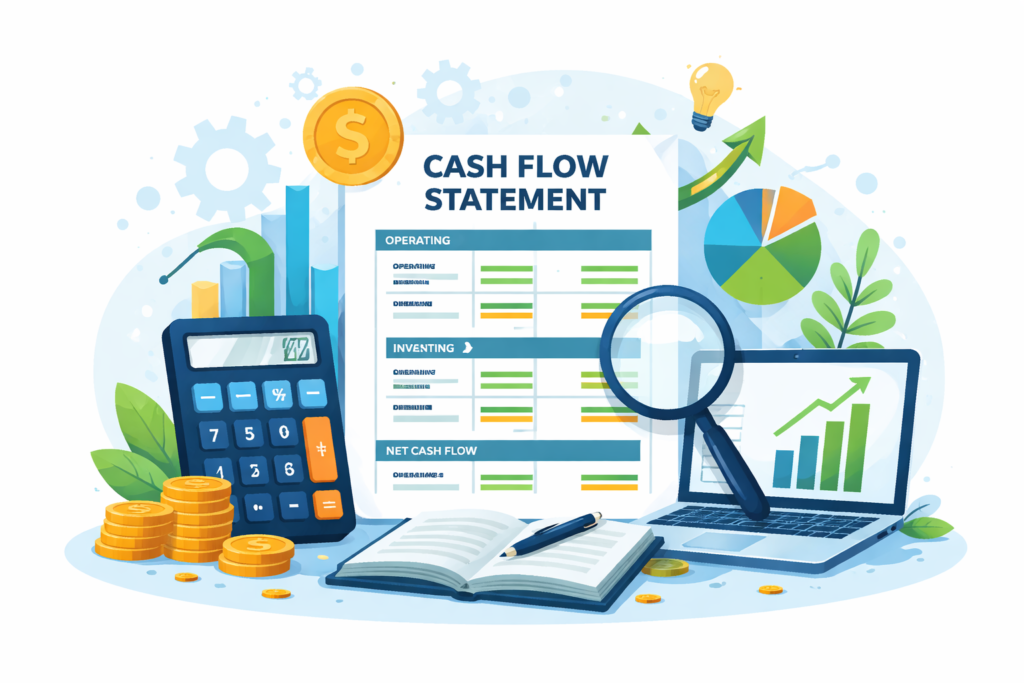
Cash Flow Statement explained in simple terms is one of the most searched accounting and investing topics for beginners, business owners, and long-term investors. A cash flow statement shows how money actually moves in and out of a business during a specific period. Unlike profit figures, it focuses on real cash — not just paper income.
If you are new to finance, understanding the cash flow statement explained in simple terms will help you know whether a business can survive, grow, and pay its bills. This guide is beginner-friendly, practical, and written in plain English so anyone can understand it without an accounting background.
Meaning / Explanation of Cash Flow Statement
A cash flow statement is a financial report that shows the actual cash generated and used by a business over a specific period, usually monthly, quarterly, or yearly. It answers one simple question: Where did the money come from and where did it go?
While profit and loss statements show income and expenses on paper, the cash flow statement focuses only on real cash movement. This is why many profitable businesses still fail — they run out of cash.
Simple Definition
A cash flow statement tracks:
- Cash coming into the business
- Cash going out of the business
- Net cash available at the end
Three Main Sections of a Cash Flow Statement
- Operating Activities – Cash from core business operations
- Investing Activities – Cash used for or earned from investments
- Financing Activities – Cash from loans, investors, or repayments
These three sections together give a complete picture of financial health.
Why Cash Flow Statement Matters
The cash flow statement matters because cash is king. No business can survive without cash, even if it looks profitable on paper.
For Business Owners
- Ensures you can pay salaries, rent, and suppliers
- Helps plan future expenses
- Prevents sudden cash shortages
For Investors
- Shows whether a company generates real money
- Helps identify financially strong companies
- Supports long-term investing decisions
Long-term investors often rely on cash flow analysis to evaluate sustainable businesses. If you are interested in long-term investing concepts, you may explore this resource:
👉 https://topstocksguide.info/category/long-term-investing/
How Cash Flow Statement Works (With Simple Example)
Let’s understand the cash flow statement with a simple example.
Example: Small Retail Shop
Opening Cash Balance: ₹50,000
Operating Activities
- Cash received from customers: ₹2,00,000
- Cash paid to suppliers: ₹1,20,000
- Salaries paid: ₹30,000
Net Operating Cash Flow: ₹50,000
Investing Activities
- Purchased equipment: ₹20,000
Net Investing Cash Flow: -₹20,000
Financing Activities
- Bank loan received: ₹30,000
Net Financing Cash Flow: ₹30,000
Final Cash Balance
Opening Balance: ₹50,000
- Net Cash Flow: ₹60,000
Closing Cash Balance: ₹1,10,000
This example shows how cash flow explains real money movement, not accounting profits.
Types of Cash Flows Explained Simply
1. Operating Cash Flow
Operating cash flow shows money generated from the main business activities. A positive operating cash flow means the business can sustain itself.
2. Investing Cash Flow
Investing cash flow shows money used for buying or selling assets such as machinery, land, or investments.
3. Financing Cash Flow
Financing cash flow shows money raised from loans, investors, or money paid back as dividends or loan repayments.
Benefits of Cash Flow Statement
1. Shows Real Financial Health
Profit can be manipulated through accounting methods, but cash flow shows reality.
2. Helps in Better Decision-Making
Businesses can plan expansion, investments, and cost control.
3. Essential for Long-Term Investors
Long-term investors prefer companies with strong and consistent cash flows. Learn more here:
👉 https://topstocksguide.info/how-long-term-investors-actually-make-money/
4. Improves Creditworthiness
Banks and lenders rely heavily on cash flow statements.
5. Identifies Liquidity Problems Early
Helps avoid cash crunch situations.
Risks and Limitations of Cash Flow Statement
1. Ignores Non-Cash Items
Depreciation and amortization are excluded.
2. Can Look Strong Temporarily
One-time cash inflows (like loans) may hide real problems.
3. Needs Comparison Over Time
Single-period analysis can be misleading.
4. Doesn’t Show Profitability
A business may have cash but still be unprofitable.
Common Mistakes and Myths About Cash Flow Statement
Myth 1: Profit Means Cash
Profit does not equal cash.
Myth 2: Only Big Companies Need Cash Flow Statements
Small businesses need it even more.
Mistake 1: Ignoring Operating Cash Flow
Operating cash flow is the most important section.
Mistake 2: Confusing Cash Flow with Revenue
Revenue is income; cash flow is actual cash.
Cash Flow Statement vs Profit & Loss Statement
| Feature | Cash Flow Statement | Profit & Loss Statement |
|---|---|---|
| Focus | Cash movement | Income & expenses |
| Shows liquidity | Yes | No |
| Includes non-cash items | No | Yes |
Both statements are important but serve different purposes.
Importance of Cash Flow in Long-Term Investing
Long-term investors focus on businesses that generate consistent free cash flow. Companies with strong cash flows can:
- Pay dividends
- Reduce debt
- Reinvest for growth
If you want to understand buy-and-hold investing principles, this guide is useful:
👉 https://topstocksguide.info/buy-and-hold-strategy-explained/
Cash Flow Statement for Beginners (Step-by-Step)
- Start with opening cash balance
- Add operating cash inflows
- Subtract operating cash outflows
- Include investing activities
- Add financing activities
- Calculate closing cash balance
This simple process helps beginners understand financial movement easily.
FAQ – Cash Flow Statement Explained in Simple Terms
1. What is a cash flow statement in simple words?
It shows how money enters and leaves a business.
2. Why is cash flow more important than profit?
Because cash pays bills; profit does not.
3. What are the three types of cash flows?
Operating, investing, and financing.
4. Can a company survive without profit?
Yes, temporarily, if it has strong cash flow.
5. Who uses cash flow statements?
Business owners, investors, lenders, and analysts.
6. Is cash flow statement mandatory?
For companies, yes; for small businesses, highly recommended.
7. What is positive cash flow?
When cash inflows exceed outflows.
8. How often should cash flow be reviewed?
Monthly or quarterly.
Advanced Insights: Understanding Cash Flow Deeper
To truly understand a cash flow statement explained in simple terms, beginners must go one step deeper and learn how cash flow behaves across different stages of a business lifecycle.
Cash Flow in Startups
Startups usually show negative cash flow in the early years. This does not automatically mean failure. Many startups intentionally spend more cash to grow faster. What matters is whether the cash is being used productively.
Key startup cash flow characteristics:
- High operating expenses
- Negative operating cash flow
- Positive financing cash flow from investors
Cash Flow in Growing Companies
Growing companies often reinvest most of their cash back into the business. Investing cash flow may be negative, but operating cash flow should slowly turn positive.
Cash Flow in Mature Companies
Mature companies usually generate stable and strong operating cash flows. These businesses:
- Pay dividends
- Reduce debt
- Buy back shares
This stage is especially attractive for long-term investors.
- Investopedia – Cash Flow Statement
- https://www.investopedia.com/terms/c/cashflowstatement.asp
- Corporate Finance Institute (CFI) – Cash Flow Statement Guide
- https://corporatefinanceinstitute.com/resources/accounting/cash-flow-statement/
- AccountingTools – What Is a Cash Flow Statement
- https://www.accountingtools.com/articles/what-is-a-cash-flow-statement.html
- Harvard Business School Online – Financial Statements Explained
- https://online.hbs.edu/blog/post/how-to-read-financial-statements
- SEC Investor Education – Understanding Financial Statements
- https://www.investor.gov/introduction-investing/investing-basics/how-read-financial-statements
Free Cash Flow Explained Simply
Free Cash Flow (FCF) is the cash left after a company pays for operating expenses and capital expenditures.
Simple Formula
Free Cash Flow = Operating Cash Flow – Capital Expenditures
Free cash flow is important because it represents money that can be:
- Paid as dividends
- Used to repay loans
- Reinvested for growth
Companies with consistent free cash flow are usually financially strong and resilient.
How Investors Analyze Cash Flow Statements
Investors do not look at cash flow statements in isolation. They combine them with other financial reports.
Key Investor Checks
- Is operating cash flow consistently positive?
- Is free cash flow growing over time?
- Is the company dependent on loans for survival?
Long-term investors often avoid businesses that rely heavily on financing cash flow to stay alive.
Cash Flow Statement in Real-Life Business Decisions
Pricing Decisions
If cash inflow is slow, businesses may revise pricing or payment terms.
Expense Control
Cash flow analysis highlights unnecessary spending.
Expansion Planning
Positive cash flow enables expansion without heavy borrowing.
Industry-Wise Cash Flow Behavior
Manufacturing Businesses
- High investing cash flow due to machinery
- Stable operating cash flow over time
Service Businesses
- Lower capital expenditure
- Strong operating cash flow if well-managed
Retail Businesses
- High working capital requirements
- Seasonal cash flow fluctuations
Understanding industry patterns helps avoid wrong conclusions.
Cash Flow Statement vs Balance Sheet
| Aspect | Cash Flow Statement | Balance Sheet |
|---|---|---|
| Time focus | Period-based | Snapshot |
| Shows liquidity | Yes | Partially |
| Decision support | Operational | Structural |
Both are essential for complete financial analysis.
Common Warning Signs in Cash Flow Statements
- Continuous negative operating cash flow
- Heavy dependence on loans
- Rising expenses without revenue growth
- Shrinking free cash flow
Spotting these signs early can prevent financial disasters.
Practical Tips for Beginners
- Always compare cash flow over multiple years
- Focus more on operating cash flow
- Do not rely only on net profit
- Learn basic financial ratios linked to cash flow
Conclusion
The cash flow statement explained in simple terms is more than just a financial document — it is a survival tool. It shows how money truly moves inside a business and reveals realities that profit figures often hide.
For beginners, understanding cash flow builds financial confidence. For business owners, it prevents cash crises. For long-term investors, it identifies sustainable wealth creators. Mastering cash flow statements is not optional — it is essential for anyone serious about financial success.
For more beginner-friendly long-term investing guides, visit:
👉 https://topstocksguide.info/long-term-investing-explained-for-beginners/
Disclaimer
This article is for educational and informational purposes only. It does not constitute financial, investment, or accounting advice. Readers should consult qualified professionals before making business or investment decisions. The author and publisher are not responsible for any financial outcomes based on this content.