
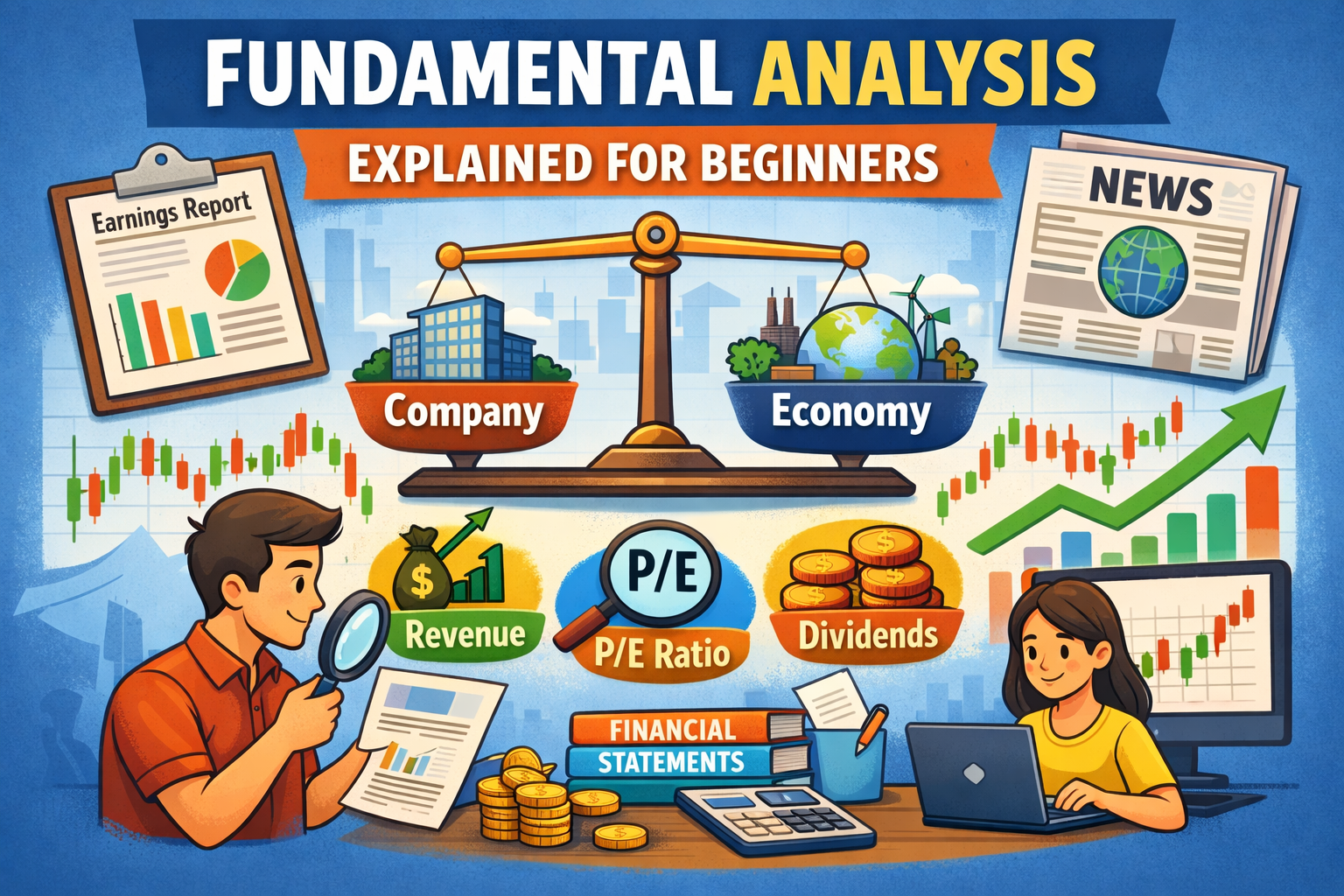
Fundamental Analysis Explained for Beginners is an essential topic for anyone who wants to understand how to judge the real value of a stock or company. Fundamental analysis helps beginners decide whether an investment is undervalued, overvalued, or fairly priced by looking at financial results, growth potential, and overall business quality.
If you are completely new to the markets, start with this detailed guide on Stock Market Basics for Beginners and then come back to this Fundamental Analysis Explained for Beginners article.
Meaning of Fundamental Analysis Explained for Beginners
In simple words, fundamental analysis means studying a business behind a stock instead of only watching its price. When Fundamental Analysis Explained for Beginners is applied correctly, the investor looks at revenue, profits, cash flow, assets, liabilities, management quality, and the economic environment.
The core idea is that every stock has an intrinsic or true value. By using Fundamental Analysis Explained for Beginners methods, an investor estimates this fair value and compares it with the current market price. If the market price is below the estimated value, the stock may be undervalued. If the price is far above the fair value, the stock may be overvalued and risky.
For example, when analysing a popular company, you do not stop at the daily price chart. Instead, you check how fast sales are growing, how much profit the company keeps after expenses, how much debt it carries, and how strong its position is compared to competitors. This is exactly what Fundamental Analysis Explained for Beginners tries to teach in a structured way.
Why Fundamental Analysis Explained for Beginners Matters
Many new investors buy and sell based on tips, rumours, or social media noise. Fundamental Analysis Explained for Beginners helps you move away from guessing and towards informed decisions. When you understand a company’s numbers and business model, you are less likely to panic during temporary price swings.
Short‑term prices are driven by emotions, but long‑term prices usually follow earnings and cash flows. By using Fundamental Analysis Explained for Beginners, you focus on the long‑term strength of the business instead of daily volatility. This approach fits perfectly with patient, long‑term investing strategies.
Fundamental Analysis Explained for Beginners is also important for students, professionals, and long‑term investors who want to build financial literacy. Once you know how to read basic financial statements and ratios, you can evaluate different companies yourself and no longer depend only on others’ opinions.
If your goal is to hold quality stocks for many years, read this related article on Long-Term Investing Explained for Beginners. It shows how Fundamental Analysis Explained for Beginners supports a patient buy‑and‑hold approach.
How Fundamental Analysis Explained for Beginners Works
To use Fundamental Analysis Explained for Beginners in real life, you can follow a simple, repeatable process. You do not need to be an expert accountant; you only need basic comfort with numbers and consistency.
- Understand the business: Start by reading what the company does, who its customers are, and how it makes money. Ask whether the product or service solves a real problem and whether the business has any competitive advantage.
- Read the income statement: This tells you how much revenue the company earns and how much profit is left after expenses. In Fundamental Analysis Explained for Beginners, focus on trends: Is revenue growing year after year? Are profit margins improving or shrinking?
- Check the balance sheet: The balance sheet lists assets, liabilities, and shareholder equity. A strong balance sheet generally means manageable debt, enough cash, and good asset quality. Weak balance sheets with high debt can be a warning sign.
- Study the cash flow statement: Cash flow shows how much real cash comes in and goes out of the business. Healthy companies usually generate positive operating cash flow. This is a key part of Fundamental Analysis Explained for Beginners because cash keeps a company alive.
- Use key ratios: Some of the most common ratios in Fundamental Analysis Explained for Beginners are:
- P/E ratio (Price to Earnings) – compares price to earnings per share.
- P/B ratio (Price to Book) – compares price to book value per share.
- ROE (Return on Equity) – measures how efficiently the company uses shareholders’ money.
- D/E ratio (Debt to Equity) – shows how much debt the company uses compared to equity.
- EPS growth – indicates whether earnings are rising over time.
- Estimate intrinsic value: After checking profits and growth, you can estimate a fair value. For beginners, a simple method in Fundamental Analysis Explained for Beginners is to multiply earnings per share by a reasonable P/E multiple based on industry averages.
- Compare with market price: Finally, compare your estimated value with the current stock price. If your calculation suggests the stock is undervalued and the business quality is good, it may be a candidate for further research or investment.
Simple numerical example: Suppose a company has earnings per share of ₹20 and the average P/E ratio in its industry is 15. Using Fundamental Analysis Explained for Beginners, you estimate fair value as 20 × 15 = ₹300. If the stock trades at ₹210, it might be undervalued, provided the business is stable and growth prospects are decent.
Top‑down and bottom‑up styles in Fundamental Analysis Explained for Beginners
There are two common styles when applying Fundamental Analysis Explained for Beginners. In the top‑down style, you first study the global and local economy, then pick strong sectors, and finally choose the best companies within those sectors. In the bottom‑up style, you focus directly on individual companies you like, and later check how they fit into the broader economic picture.
Key Components in Fundamental Analysis Explained for Beginners
- Economic analysis: Growth rates, interest rates, inflation, and government policies can support or hurt certain sectors.
- Industry analysis: Look at competition, barriers to entry, regulatory changes, and demand trends. A company in a shrinking industry may struggle even if it is well managed.
- Company analysis: Study leadership quality, corporate governance, new product plans, and how the company treats shareholders.
For a smoother learning journey, many readers first learn terminology like stocks, indices, and order types from the article Stock Market Basics for Beginners and then apply Fundamental Analysis Explained for Beginners as a second step.
Benefits of Fundamental Analysis Explained for Beginners
Using Fundamental Analysis Explained for Beginners regularly can give strong advantages to long‑term investors. Some of the most important benefits are listed below.
- Better decision‑making: You base decisions on financial facts rather than rumours or short‑term price movements.
- Understanding real business value: Fundamental Analysis Explained for Beginners teaches you how to judge whether a company is truly strong or just popular for a while.
- Support for long‑term investing: When you know why you bought a stock, you are more comfortable holding it through temporary corrections.
- Improved risk control: By checking debt levels, cash flow, and profit stability, you can avoid companies with hidden problems.
- Ability to compare companies: Ratios and trends let you compare several companies in the same sector and choose the best candidates.
- Foundation for professional research: Many professional analysts use the same principles that are taught in Fundamental Analysis Explained for Beginners, just with more detailed models.
- Stronger confidence: Once you understand how to read numbers, media headlines become less confusing and you feel more in control of your money.
Risks and Limitations of Fundamental Analysis Explained for Beginners
Even though Fundamental Analysis Explained for Beginners is very useful, it has limits and cannot guarantee profits. Knowing these limits keeps expectations realistic.
- Dependent on assumptions: Any estimate of intrinsic value depends on assumptions about future growth and profit margins. If those assumptions are wrong, your valuation will also be wrong.
- Time and effort: Reading reports and comparing companies takes time. Some investors may find it difficult to stay consistent.
- Market can stay irrational: A fundamentally strong stock can remain undervalued for months or years if the market mood is negative. Patience is required.
- Limited help for short‑term trading: Fundamental Analysis Explained for Beginners focuses on long‑term business performance, not on predicting intraday or weekly price moves.
- Data quality issues: Sometimes financial statements are complex or contain one‑time items that make analysis harder for beginners.
- Different views: Two investors can look at the same company and reach different conclusions because they use different assumptions, risk levels, or time horizons.
Common Mistakes and Myths in Fundamental Analysis Explained for Beginners
New investors often repeat the same mistakes when they try to use Fundamental Analysis Explained for Beginners. Avoiding these errors can save both money and time.
- Myth: A low P/E always means a bargain. Sometimes a low P/E is low because earnings are about to fall or the business is in decline. Always check the reasons behind the number.
- Myth: High profit equals a great investment. A company may show high profit today but also require huge future spending or carry heavy debt. Cash flow and balance sheet strength matter just as much.
- Myth: Only experts can do analysis. Fundamental Analysis Explained for Beginners shows that with basic training and regular practice, any serious investor can understand key concepts.
- Mistake: Looking only at one year. Always check at least three to five years of data to see trends instead of one‑time spikes or drops.
- Mistake: Ignoring management quality. Good numbers can quickly deteriorate if management changes direction, takes on too much debt, or treats minority shareholders poorly.
- Mistake: Forgetting industry trends. A company can be well‑managed but still suffer if the entire industry faces disruption or shrinking demand.
- Mistake: No exit plan. Even when using Fundamental Analysis Explained for Beginners, investors should think about situations where they would sell: for example, serious deterioration in fundamentals or a big change in business model.
Practical Steps for Beginners Using Fundamental Analysis Explained for Beginners
Here is a simple action plan you can follow to apply Fundamental Analysis Explained for Beginners to your next stock idea.
- Read a basic stock market guide like Stock Market Basics for Beginners so that basic terms such as shares, orders, and indices are clear.
- Pick one or two familiar companies whose products you use in daily life. It is easier to apply Fundamental Analysis Explained for Beginners when you understand the business.
- Download their last three to five annual reports from the stock exchange or company website.
- Note down revenue, net profit, earnings per share, debt, and cash for each year in a simple spreadsheet.
- Calculate a few basic ratios like P/E, P/B, ROE, and D/E. You can also use free online screeners or broker platforms to find these numbers quickly.
- Write a short summary of why you like or do not like the company after applying Fundamental Analysis Explained for Beginners.
- Start a small paper portfolio and track your chosen stocks for at least three to six months before investing real money.
- When you feel confident, combine this approach with ideas from Long-Term Investing Explained for Beginners to build a slow and steady portfolio.
FAQ Section for Fundamental Analysis Explained for Beginners
1. What is the main goal of Fundamental Analysis Explained for Beginners?
The main goal is to help new investors estimate the intrinsic value of a stock or business by studying its financial statements, business model, and growth prospects, instead of relying only on price charts.
2. Is Fundamental Analysis Explained for Beginners suitable for complete newbies?
Yes. As long as you are willing to learn basic terms and practise regularly, Fundamental Analysis Explained for Beginners is one of the safest ways to start understanding how companies really work.
3. Which documents are most important in Fundamental Analysis Explained for Beginners?
The income statement, balance sheet, cash flow statement, and annual report are the main sources. Together they show profits, assets, debt, and how much cash the business actually produces.
4. How is Fundamental Analysis Explained for Beginners different from technical analysis?
Fundamental Analysis Explained for Beginners focuses on business performance and value, while technical analysis focuses on price patterns and trading volume. Many investors use both together.
5. Can Fundamental Analysis Explained for Beginners predict short‑term price movements?
No. It is designed mainly for long‑term decision‑making. Short‑term prices can move due to news, rumours, or sudden market sentiment changes that fundamentals do not capture immediately.
6. How often should I repeat my analysis?
Many investors update their Fundamental Analysis Explained for Beginners checklist every quarter after results and whenever there is big news such as a merger, major debt change, or management resignation.
7. What tools can help with Fundamental Analysis Explained for Beginners?
Free stock screeners, broker research tools, company investor‑relations pages, and annual reports are very useful. Simple spreadsheet software is enough for most calculations.
8. Can Fundamental Analysis Explained for Beginners be used for mutual funds or ETFs?
Yes. You can apply similar thinking by checking the underlying holdings, expense ratio, historical performance, and how the fund manager chooses stocks.
9. Should I rely only on Fundamental Analysis Explained for Beginners?
It is a strong foundation, but you should also consider your own risk tolerance, asset allocation, basic technical levels, and overall financial plan.
10. How long does it take to become comfortable with Fundamental Analysis Explained for Beginners?
Most people gain basic comfort within a few months of regular practice. Mastery takes longer, but consistent reading and analysing one company at a time builds skill steadily.
Conclusion
Fundamental Analysis Explained for Beginners is not about predicting the market perfectly; it is about understanding what you own and why you own it. By focusing on earnings, debt levels, cash flow, and competitive strength, you give yourself a logical framework instead of depending on random tips.
When combined with patience, diversification, and a long‑term mindset, Fundamental Analysis Explained for Beginners can help you avoid many common investing mistakes and slowly build a portfolio of quality businesses. Keep learning, keep reviewing your assumptions, and use this method as a guiding tool rather than a guarantee.
Disclaimer: This article is for educational purposes only and does not constitute financial advice. Always consult a qualified financial advisor before making any investment decisions.