
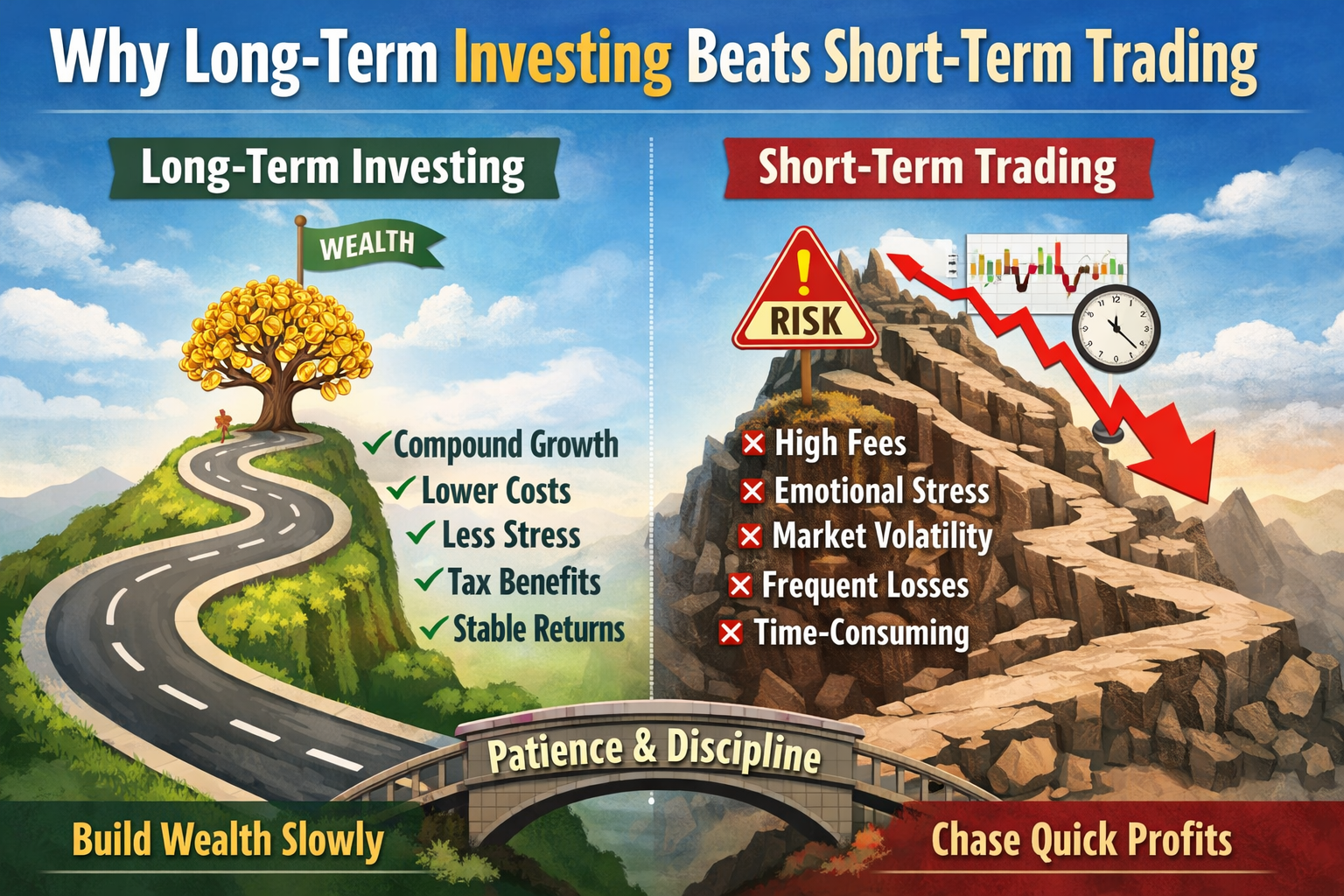
Why long term investing beats short term trading is one of the most important ideas new investors must understand before risking money in the stock market. Long term investing beats short term trading for most people because it relies on patience, compounding, and disciplined decision-making rather than constant buying and selling.
Many beginners enter the stock market hoping for quick profits, often influenced by social media, news headlines, or success stories of traders. While short term trading may look attractive, the reality is very different for most individuals. This beginner-friendly article explains why long term investing consistently outperforms short term trading, how it works, and how you can apply it wisely to achieve financial stability.
Meaning / Explanation of Why Long Term Investing Beats Short Term Trading
Long term investing is a strategy where investors buy assets such as stocks, mutual funds, or ETFs and hold them for an extended period—usually years or decades. The main goal behind why long term investing beats short term trading is that investors benefit from business growth, dividends, and compounding returns rather than short term price movements.
Short term trading involves frequent buying and selling of financial instruments to capture small price changes. Traders rely heavily on technical analysis, market timing, and quick decision-making. While some professionals succeed, most retail traders struggle due to high costs, taxes, and emotional pressure.
If you are new to the stock market, understanding the step-by-step working of the stock market can help you see more clearly why long term investing beats short term trading for everyday investors.
Why It Matters That Long Term Investing Beats Short Term Trading
Knowing exactly why long term investing beats short term trading matters because your financial strategy directly affects your future goals—such as buying a home, funding education, or retiring comfortably. Many investors lose money not because markets fail, but because they follow unsuitable short term strategies.
Markets reward patience. Over time, companies grow, economies expand, and innovation drives profits higher. Long term investors benefit from these trends, while short term traders often react to noise rather than fundamentals, which is another reason why long term investing beats short term trading in real life.
For beginners, learning stock market basics early can prevent costly mistakes and unrealistic expectations.
How It Works / Example Showing Why Long Term Investing Beats Short Term Trading
Long term investing works by staying invested through market cycles—both good and bad. Instead of trying to predict daily movements, investors focus on quality assets and allow time to work in their favor, which is central to why long term investing beats short term trading.
Example:
Assume two investors start with ₹1,00,000.
- Investor A: Invests in a diversified equity fund and holds it for 25 years, following the logic of why long term investing beats short term trading.
- Investor B: Trades stocks frequently based on short term trends.
If Investor A earns an average return of 11–12% annually, compounding can multiply the investment several times. Investor B may earn profits occasionally but also faces losses, transaction costs, and higher taxes that weaken the short term trading strategy.
Understanding long term investing principles helps investors stay confident during temporary market declines and strengthens their belief in why long term investing beats short term trading.
Benefits: Key Reasons Why Long Term Investing Beats Short Term Trading
Long term investing offers multiple advantages that short term trading cannot consistently match, which together explain why long term investing beats short term trading.
- Power of Compounding: Earnings generate additional earnings over time, which is a key reason why long term investing beats short term trading for patient investors.
- Lower Costs: Fewer trades reduce brokerage and tax expenses, while frequent short term trading increases hidden costs.
- Emotional Stability: Long term investors are less affected by daily price swings and news-driven market noise.
- Time Efficiency: There is no need to track markets constantly or sit in front of charts all day.
- Higher Success Rate: Historically, diversified long term investors tend to outperform most active traders over many years.[web:1][web:2][web:3][web:6][web:9][web:12][web:15]
By focusing on strong businesses and diversified funds, investors benefit from economic growth while avoiding unnecessary complexity and stress that comes with short term trading.
Risks / Limitations Even When Long Term Investing Beats Short Term Trading
Although long term investing is effective and explains why long term investing beats short term trading, it still carries risks that every investor should understand.
- Market Volatility: Prices may fall in the short term even when long term fundamentals remain strong.
- Company-Specific Risk: Individual businesses can fail, which is why diversification is important.
- Inflation Risk: Poor asset choices may not beat inflation, reducing real purchasing power over time.
- Patience Required: Results take time, and investors must stay disciplined even during temporary setbacks.
These risks can be minimized through diversification and proper fundamental analysis before investing, which is easier to apply in a long term investing strategy than in fast short term trading.
Common Mistakes / Myths About Why Long Term Investing Beats Short Term Trading
- Myth: Long term investing means no risk.
Reality: Risk exists but is manageable over time with diversification, asset allocation, and realistic expectations. - Myth: Trading daily increases profits.
Reality: Overtrading often reduces returns because of costs, taxes, and emotional decisions, which is the opposite of why long term investing beats short term trading. - Mistake: Panic selling during market corrections instead of remembering why long term investing beats short term trading during volatile phases.
- Mistake: Following tips without research and confusing speculation with true long term investing.
Successful investors understand that consistency and discipline matter more than speed, and that a solid long term plan usually beats random short term trades.
Long Term Investing vs Trading: Deeper Insights
To understand why long term investing beats short term trading for most people, it helps to look at how markets behave over long periods and how traders actually perform in the real world. Historical market data shows that broad stock indices have delivered attractive average annual returns over multi-decade periods for patient investors who stayed invested.[web:8][web:14][web:17][web:20]
For example, research on major equity indices such as the S&P 500 and Nifty 50 shows strong average yearly returns over long stretches when dividends are reinvested, even after including multiple crashes and bear markets.[web:8][web:14][web:17][web:20] Over 20–30 year horizons, the probability of positive returns becomes very high, which strongly supports a long term, buy-and-hold approach for wealth building.
On the other hand, studies on day trading and very short term trading show that a large majority of active traders lose money, and only a small percentage manage to stay consistently profitable over time.[web:7][web:10][web:13][web:16][web:19] This gap between market-level returns and individual trader outcomes is one major reason why long term investing beats short term trading for typical investors.
Evidence: How Many Traders Lose?
Many beginners assume that with enough effort or tips, they can become successful traders quickly, but real-world statistics are much harsher. Analyses of trading accounts in different markets have found that most active retail traders lose money, especially in intraday and derivatives trading.[web:7][web:13][web:16]
Some reports indicate that around 90–95% of day traders eventually lose capital or underperform simple index investing, and a significant portion quit within the first few years.[web:7][web:19] Even when a small group of traders earns profits, their success is often concentrated in a tiny percentage, while the majority underperform.
These numbers highlight an uncomfortable truth: active trading may look glamorous, but it is extremely competitive and unforgiving. For someone with a regular job, limited time, and average market knowledge, the odds are stacked against consistent trading success, which again explains why long term investing beats short term trading for most people.
Role of Compounding Over Decades
Compounding is one of the strongest reasons why long term investing beats short term trading, especially when investments are allowed to grow for 15–30 years or more. When returns are reinvested, each year’s gains start earning additional returns, leading to exponential growth instead of linear growth.
For example, if an investor earns 11–12% per year on average and stays invested for 20–25 years, the original capital can multiply several times without any need for frequent buying and selling.[web:5][web:18] Even modest monthly SIP-style contributions, when compounded over decades, can create a sizable corpus for retirement or other long term goals.
Short term traders, in contrast, often interrupt compounding by moving in and out of positions, keeping cash idle, or suffering drawdowns that take time to recover. Frequent losses in trading also mean that part of the capital is constantly being used to make up for previous mistakes, which limits the benefits of compounding.
Costs, Taxes, and Hidden Leakage
Another important reason why long term investing beats short term trading is the difference in costs between long term and short term approaches. Short term trading involves frequent order placement, higher turnover, and sometimes leverage, all of which increase brokerage charges, bid–ask spreads, and other transaction costs.[web:2][web:4][web:6][web:9][web:12][web:15]
In many countries, tax rules also reward long term investing through lower long term capital gains tax rates compared to short term gains.[web:2][web:4] When an investor trades frequently, more of the profit is classified as short term and taxed at higher rates, which eats into net returns. Over years, this tax drag can significantly reduce wealth creation.
Long term investors, on the other hand, usually make fewer transactions and hold positions for years, which keeps brokerage costs and taxes relatively low. This cost advantage compounds silently in the background, adding to the benefits of staying invested instead of chasing every small price move.
Psychology: Emotions in Trading vs Investing
Human psychology plays a big role in financial outcomes, and this is where long term investing again has an edge over short term trading. Short term trading demands quick reactions, tolerance for rapid gains and losses, and the ability to stick to a plan under intense pressure.
Common emotional mistakes include overtrading after a loss to “recover quickly,” increasing position sizes without proper risk management, and exiting good trades too early out of fear.[web:6][web:9][web:12][web:15] These patterns slowly erode capital and confidence, even if the trader understands technical setups in theory.
Long term investing reduces the frequency of decision-making and helps investors ignore daily price noise. By focusing on business quality, long term trends, and asset allocation, investors can build a calmer relationship with markets, which is another reason why long term investing beats short term trading for people who value peace of mind.
Practical Steps to Start Long Term Investing
Beginners who want to move away from speculative trading and build a long term investing framework can follow a simple, structured approach. The focus should be on clarity of goals, disciplined contributions, and basic understanding of products rather than on complex strategies.[web:3][web:4][web:6][web:9][web:12][web:15]
- Step 1 – Define goals: Decide why you are investing—retirement, children’s education, house purchase, or wealth creation over 15–25 years.
- Step 2 – Choose products: For most small investors, diversified equity mutual funds, index funds, or ETFs are a simple starting point. Direct stocks can be added gradually after learning fundamentals.
- Step 3 – Start SIPs: Set up monthly SIPs so that investing becomes an automatic habit instead of an occasional decision based on market mood.
- Step 4 – Diversify: Spread money across sectors, market caps, and a mix of equity, debt, and gold depending on risk tolerance.
- Step 5 – Review calmly: Check your portfolio once or twice a year, rebalance if needed, and avoid reacting to every piece of news.
This type of simple, long term plan usually beats random trading tips, social media recommendations, or frequent churning of a handful of stocks. Over time, even conservative, disciplined investing can deliver better and more predictable results than aggressive trading without a clear edge.
When Trading May Still Make Sense
Even though long term investing beats short term trading for most people, trading is not always “bad” or useless. In certain situations, short term or medium-term trading can make sense, but it requires the right mindset, skills, and risk controls.
- Genuine edge: A trader who has tested strategies, understands risk management, and maintains detailed trading records may be able to trade responsibly with a small part of capital.
- Limited allocation: Short term trading, if attempted, should be done with money you can afford to lose, while core wealth remains in long term investments.
- Clear rules: Stop-loss levels, position sizing, and maximum daily loss limits are essential to prevent emotional blow-ups.
- Time and focus: Trading is closer to running a small business than to passive investing; it demands serious time, learning, and discipline.
By separating long term investing from speculative trading, individuals can avoid mixing emotions and prevent a few bad trades from damaging their entire financial future. Treat long term investments as non-negotiable core wealth, and treat trading, if any, as an experimental side activity.
FAQ Section
1. Why does long term investing outperform trading?
Why long term investing beats short term trading is mainly due to compounding, lower costs, fewer emotional errors, and the fact that broad markets tend to rise with economic growth over long periods.[web:1][web:2][web:3][web:6][web:9][web:12][web:15]
2. Is long term investing suitable for small investors?
Yes, even small amounts invested regularly can grow significantly over time. Systematic investment plans (SIPs) in mutual funds or periodic investments in index funds allow small investors to benefit from compounding and market growth.[web:3][web:4][web:5]
3. Can beginners try short term trading?
Beginners should first understand fundamentals before attempting high-risk trading strategies. If they still want to trade later, it is safer to use only a small portion of their capital and to treat it as learning rather than guaranteed income.[web:6][web:9][web:12][web:15]
4. What role does diversification play?
Diversification spreads risk and protects against major losses. By investing in multiple sectors and companies, the impact of any single failure on the total portfolio is reduced, which supports smoother long term growth.[web:3][web:4][web:6]
5. How often should investments be monitored?
Once or twice a year is sufficient for long term investors. Reviewing too frequently encourages unnecessary reactions to short term volatility and can tempt investors to churn their portfolios.[web:1][web:3][web:15]
6. Are market crashes bad for long term investors?
No, they often provide opportunities to invest at lower prices. For investors with a long horizon and ongoing income, crashes can actually improve long term returns if they continue investing systematically.[web:1][web:5][web:18]
7. Do long term investors need technical analysis?
Fundamental analysis is more important than technical analysis for long term investing. Basic understanding of business quality, earnings growth, debt levels, and competitive advantage usually matters more than short term chart patterns.[web:4][web:5][web:6]
8. How long is truly “long term”?
In equity investing, a period of at least 7–10 years is generally considered long term because it covers multiple market cycles. For goals like retirement, holding periods of 15–30 years or more are common.[web:3][web:4][web:5]
9. Should long term investors ever sell?
Yes, selling can be sensible if the original investment thesis has failed, the company’s fundamentals have deteriorated, or the asset no longer fits your goals or risk profile. Rebalancing occasionally is part of healthy portfolio management.[web:3][web:4]
10. Can long term investing and trading be combined?
They can be combined carefully by keeping clear boundaries. Core capital should stay in long term investments, while any trading activity should be done with a strictly limited portion of funds and a well-defined plan, which preserves the advantages of long term investing while allowing controlled experimentation with trading.[web:6][web:9][web:12][web:15]
Conclusion
In simple words, why long term investing beats short term trading comes down to math, behavior, and time working together in your favor. Instead of chasing quick profits, long term investors focus on quality assets, patience, and compounding, which together create a powerful formula for building sustainable wealth.
By understanding market basics, applying fundamental analysis, and staying invested through market cycles, individuals can achieve long term financial goals with confidence. For most people, the combination of long horizons, diversification, and regular investing offers a far better and safer path than attempting to outsmart the market on a daily basis through short term trading.
Disclaimer: This article is for educational purposes only and does not constitute financial advice. Always consult a qualified financial advisor before investing.
Source for external statistics: Investopedia – Is Day Trading Profitable?